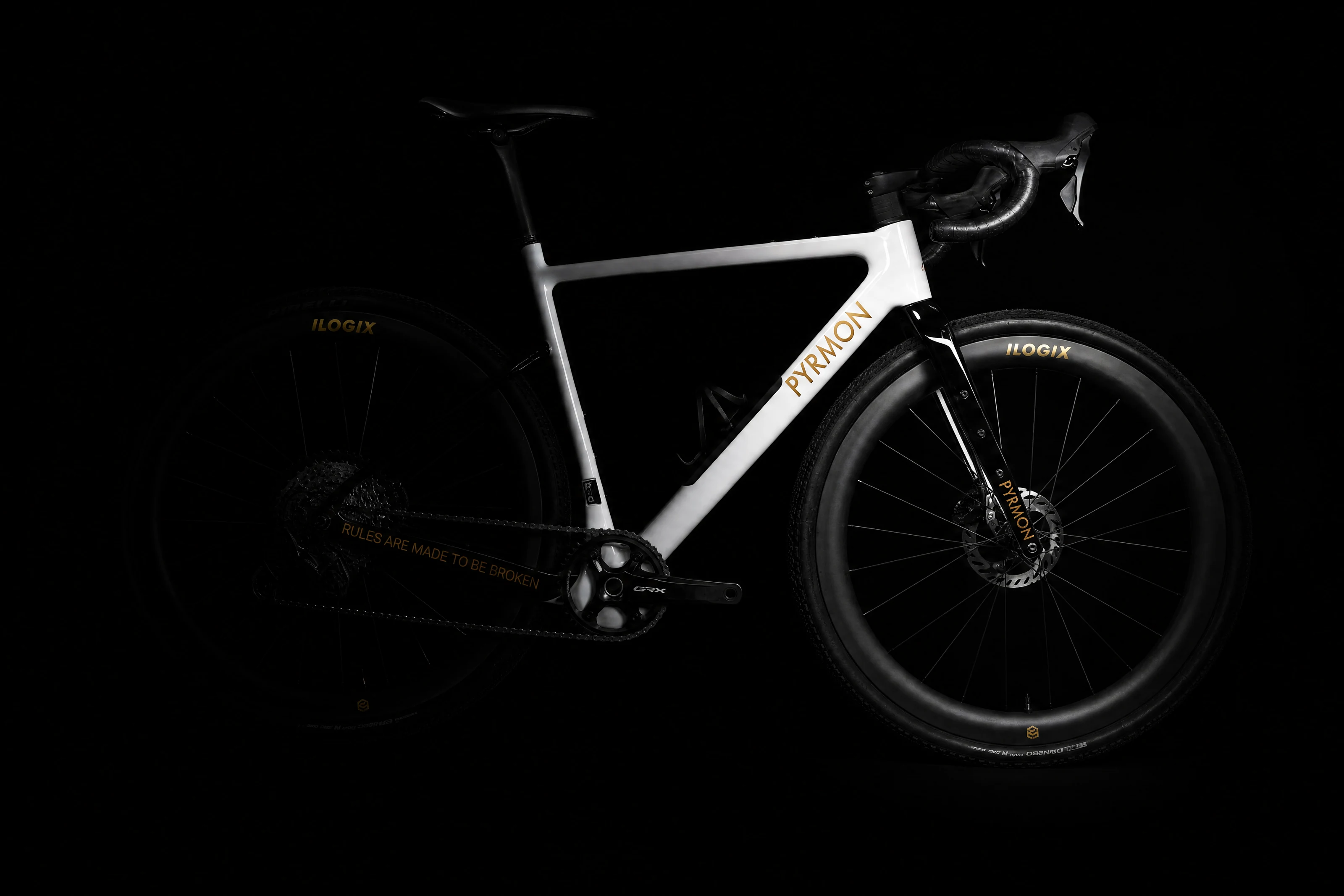
"High-end" is one of cycling's most abused labels: you will see it on a €2,000 bike and on a €12,000 one. But the line is real, it can be explained with facts, and knowing where it sits can save you a lot of money. This is our honest answer, written from a workshop that builds the Canigó, to the question we get asked most: how much should you expect to pay for a carbon gravel bike with a solid groupset?
The four price brackets of gravel
Simplifying a huge market, a new gravel bike lives in one of four territories. Up to €2,500 you will find aluminium or entry-level carbon with mechanical groupsets: honest bikes to discover the discipline. Between €2,500 and €4,000 comes mainstream carbon with better groupsets and more serious wheels. Between €4,000 and €6,500 sits the real high end: quality carbon, a complete gravel-specific groupset, carbon wheels and weights clearly under 9 kg. Above €6,500 you enter racing territory and limited editions, where every extra gram saved costs serious money.
The frame: not all carbon is equal
The word "carbon" hides very different realities. Cheap catalogues are full of generic open moulds: frames bought off the shelf, with extra plies of fibre added for safety, which weigh more and respond worse. A high-end frame is engineered: every zone gets the fibre type and orientation it needs, stiff at the bottom bracket and head tube, more forgiving in the rear triangle so it filters the terrain. You cannot see the difference in a photo, but you feel it in the first gravel descent.
Where the jump shows: complete groupsets, not mixed ones
A common trick to cut costs: advertise the good groupset and fit only half of it, with brakes, chain or cassette from a lower tier. On a high-end gravel bike the groupset is complete. Our reference is the full Shimano GRX 12-speed, and we hold the wheels to the same standard: carbon, because rotating mass is the weight you notice most when you accelerate or when the track tilts up. If budget forces a choice, good wheels transform a bike more than any other component.
Weight: the number that sums it (almost) all up
Weight is not a vanity metric: it is the summary of every decision above. A complete high-end gravel bike sits between 8 and 9 kg. The Canigó weighs 8.3 kg with GRX 12-speed and carbon wheels. When you see "carbon" and the scale reads 10 kg, the carbon is only there in name: something, somewhere, was cut.
What the price bracket does not tell you
Two bikes can cost the same and be very different products. At PYRMON every bike is assembled and checked one by one in our Taradell workshop, carries a 5-year warranty with Crash Replacement, and if you ever have a problem you talk to the same hands that built it. That is what bikes made in Catalonia give you: service is not a form, it is an address.
The short answer
A high-end carbon gravel bike costs between €4,000 and €6,500: below that it is hard to fit a properly engineered frame, a complete groupset and carbon wheels; above it you are paying for racing grams most riders will never need. The Canigó costs €4,899 and is exactly how we understand that bracket.
If you are still working out the basics (geometry, sizing, tyres), start with our guide to choosing a carbon gravel bike. And if you want to see what all of this means on a real bike, come and see the Canigó at the workshop: we are in Taradell, an hour from Barcelona.