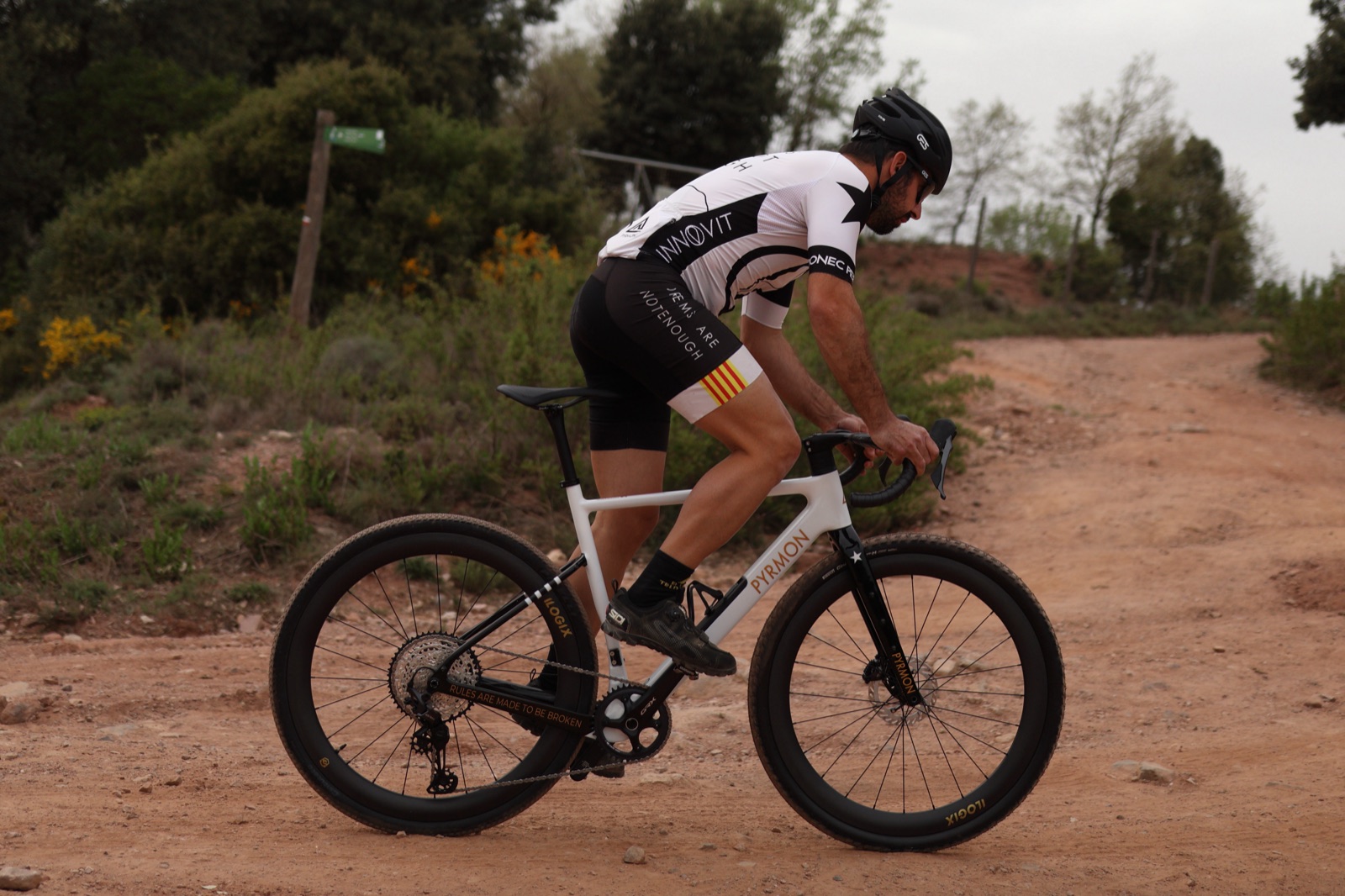
A carbon gravel bike is probably the most versatile purchase a cyclist can make today: it works for long road rides, forest tracks and bikepacking. But the market is a jungle of acronyms and prices. This guide sums up what we look at when we build one, so you can compare any brand with clear criteria, ours included.
Why carbon and not aluminium
For gravel, carbon has two advantages you feel on every ride: it weighs less and it filters terrain vibration better. An equivalent aluminium frame is usually 400 to 700 grams heavier and sends more fatigue to your hands and lower back on broken tracks. Carbon also lets the builder tune stiffness by zone: stiff at the bottom bracket, where you put the power, and more forgiving at the rear triangle, which is what absorbs the road.
The groupset: reliable shifting above all
On gravel the drivetrain works dirty: dust, mud, vibration. That is why gravel-specific groupsets are worth it. Twelve-speed Shimano GRX is today's reference: levers designed for rough terrain, a protected derailleur and wide gearing to climb steep tracks fully loaded. It is the groupset on our Canigó, with a 10-51 cassette so you never run out of gears.
Geometry: stability without going numb
A gravel bike is not a road bike with fat tyres. Look for three things in the geometry chart: a slacker head angle than a road bike (71-72 degrees) for stability on loose descents, a contained reach to stay comfortable for hours, and a wheelbase long enough to keep calm when the wheel dances. Every one of our product pages includes the full geometry chart per size.
Sizing: the thing nobody should guess
No geometry saves a wrong size. As a quick reference, for the Canigó we work with height ranges: XS from 153 to 162 cm, S from 163 to 172, M from 173 to 182, L from 183 to 192 and XL from 193 to 202. If you sit between two sizes, torso and arm length decide. When in doubt, write to us and we will look at it with you, no strings attached.
Wheels and tyres: where comfort is won
Carbon wheels are not a luxury on gravel: they save weight where it matters most (rotating mass) and take hits better than light aluminium ones. With tyres the rule is simple: 40 mm width or more, tubeless setup and low pressures. The comfort difference against a 35 mm tyre with a tube is enormous.
What a good carbon gravel bike costs
In 2026, a carbon gravel bike with a reliable groupset starts around €2,500 from the big brands, with entry-level parts. From €4,000 upwards you find better carbon, carbon wheels and high-end groupsets. Our Canigó costs €4,899 with GRX 12-speed, carbon wheels and 8.3 kg total weight, plus what the numbers do not show: every unit is assembled and checked one by one, with a 5-year warranty and Crash Replacement.
The guide in short
- Frame: carbon, with stiffness tuned by zone.
- Groupset: gravel-specific; GRX 12-speed as the benchmark.
- Geometry: slack head angle, contained reach, stable wheelbase.
- Size: check the height range and ask if you are on the edge.
- Wheels: carbon if the budget allows; 40 mm tubeless tyres.
- Price: distrust carbon that is too cheap; always ask about the warranty.
If after reading this you want to see how we apply each point on a real bike, the Canigó spec sheet is our answer. And if you would rather talk it through with someone from the workshop, here we are.