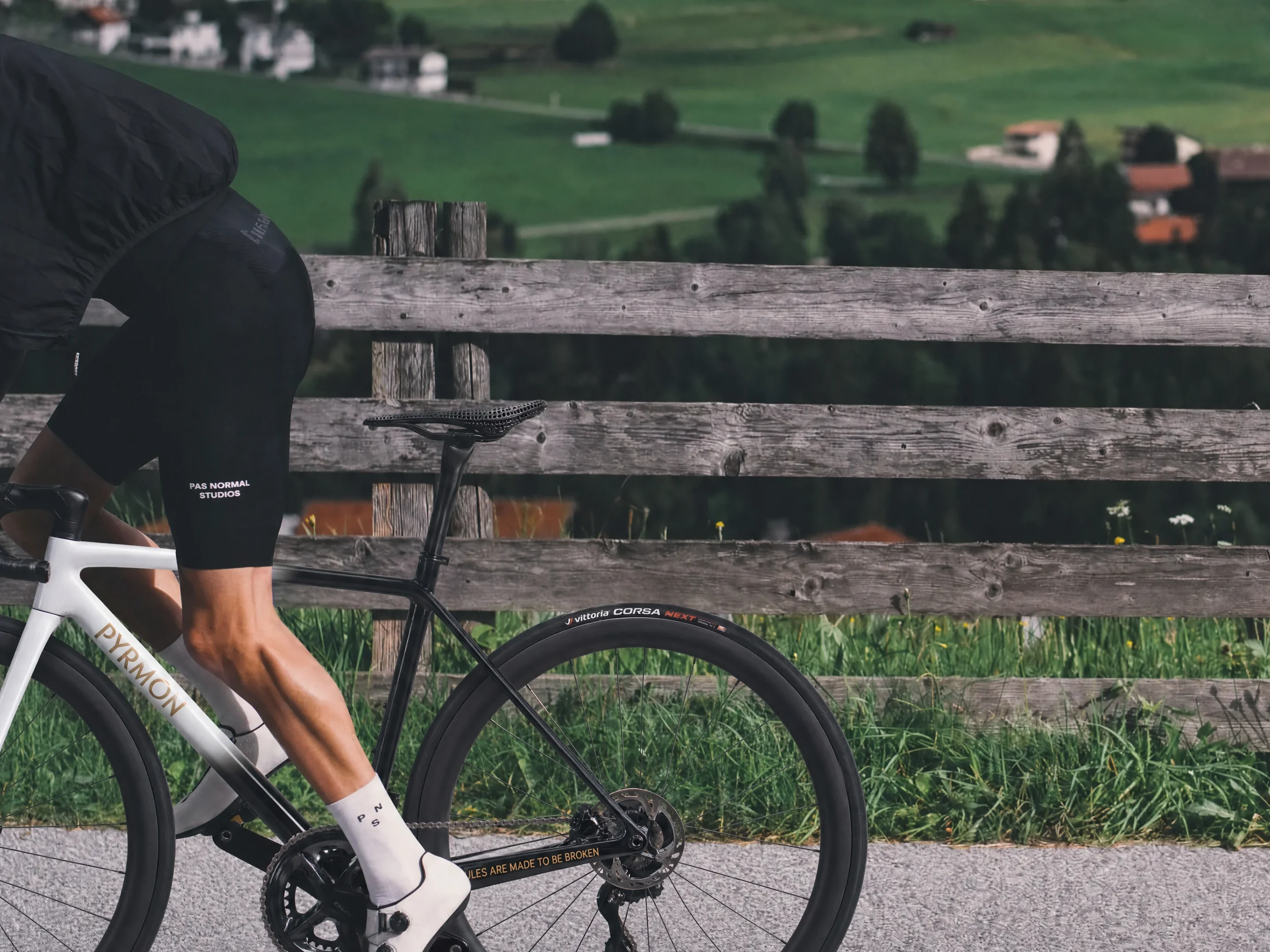
Modern road bikes have split into two families: aero bikes, designed to cut through the wind, and climbing bikes, designed to weigh little and go uphill faster. A climbing bike is exactly that: a machine where every decision (frame, wheels, components) serves one goal, going faster for the same effort when the road tilts up. Ours is the Cadí, and in this article we explain what makes a bike a climber and how to know if it is what you need.
What defines a climbing bike
Three things. Weight: the ruling factor; a modern climbing frame sits around 800 grams (the Cadí's weighs 830) and the complete bike should stay clearly under 7.5 kg. Bottom bracket stiffness: climbing at low speed every pedal stroke counts, and a flexing bottom bracket eats watts. Geometry: an efficient position for long seated climbs and stable handling, because everything you climb you will have to descend.
Climbing bike or aero bike: the honest decision
The physics are simple: aerodynamics rule when you ride fast on the flat, and weight rules when the gradient goes past 6-7%, which is when speed drops and the wind stops being the enemy. So the question is not which bike is better, but what your riding looks like. If your big days are measured in metres of climbing and your calendar is a list of cols, you want a climbing bike. If what excites you is flat-out speed and sprinting, look at our aero bike, the Carlit. If you are torn between the two, the answer is usually the terrain outside your door.
The details that make the difference
On a serious climbing bike we look for precise electronic shifting with wide gearing to hold cadence on steep ramps (the Cadí runs Shimano Dura-Ace Di2, and on the blog we explain what it adds over Ultegra), light mid-depth wheels that accelerate without punishing you in crosswinds, and all the invisible grams: seatpost, bars, saddle. The Cadí's saddle is 3D printed: less weight and more comfort on long climbs.
When you do NOT want one
If 90% of your kilometres are flat, a climbing bike is a wonderful machine that will never play on its own terrain. On the flat, between an equivalent climber and an aero bike there are watts of difference in the aero bike's favour, and no col to win them back. Be honest about your terrain: it is the only question that matters.
Our climbing bike: the Cadí
The Cadí is our answer: an 830-gram frame, 7.2 kg overall, Dura-Ace Di2 and a 3D-printed saddle, for €8,999 with a 5-year warranty. Built in Catalonia, next to the climbs it was designed for. If you want to see it up close, come to the workshop in Taradell: we will walk you through every decision with the bike in front of you.